

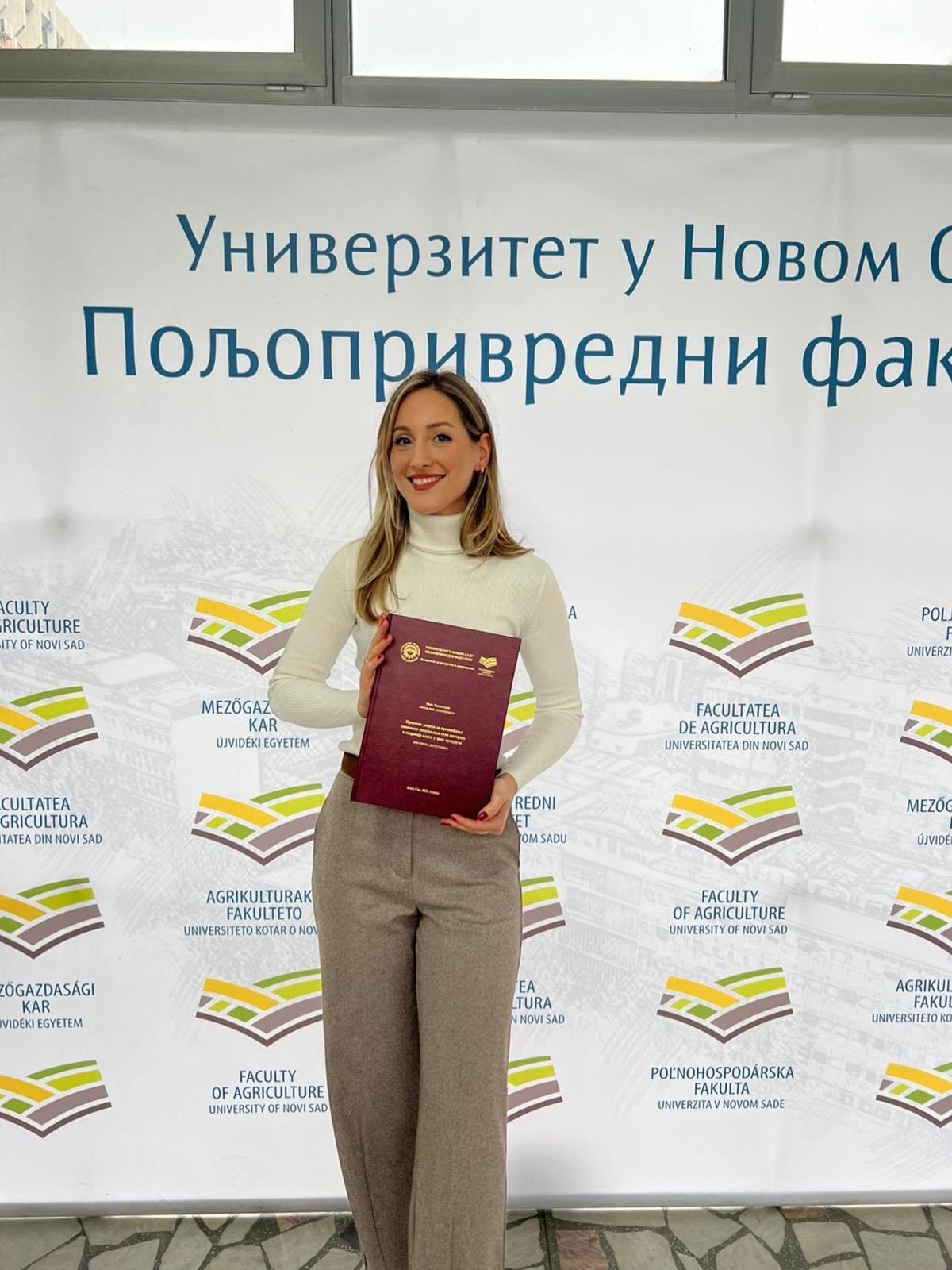
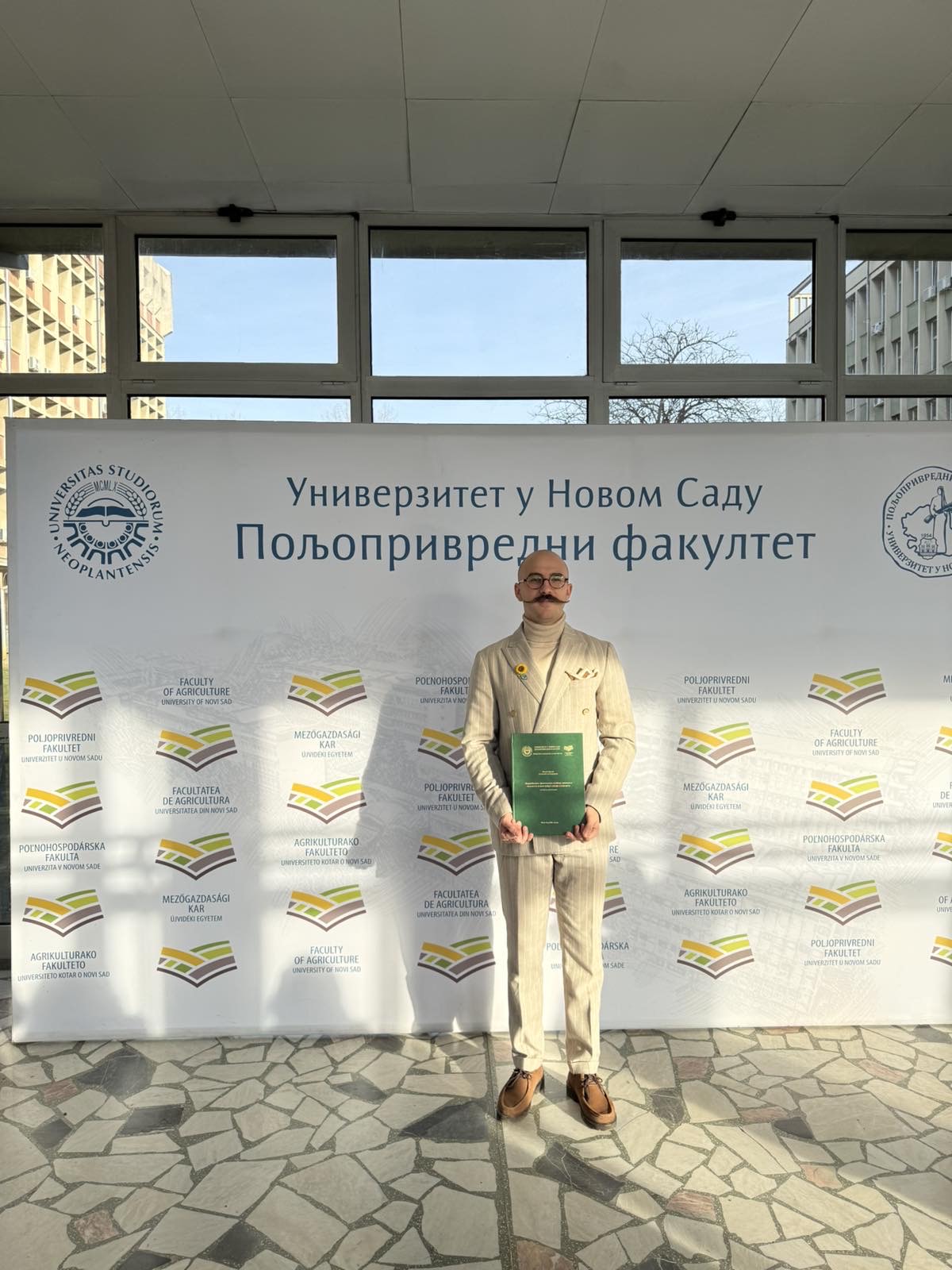
Members and young researchers of the Climate Crops Centre, Dr Miloš Krstić and Dr Maja Tanasković, successfully defended their PhD theses under the supervision of Prof. Dr Velimir Mladenov at the Faculty of Agriculture, University of Novi Sad, on 9th and 11th December 2025, which once again confirms the high level of professional and scientific potential of young researchers.
Dr Miloš Krstić defended his doctoral dissertation entitled “Variability of Phenotypic Traits, Yield and Seed Quality of Sunflower Inbred Lines“, with additional mentoring support from Dr Jelena Ovuka (Institute of Field and Vegetable Crops). Within his research, Miloš analyzed the effects of genotype, sowing date, and their interaction on yield stability and magnitude, as well as on seed quality during sunflower seed production under diverse climatic conditions over multiple years. The results demonstrated that the genotype × sowing date interaction is not uniform, highlighting the need for precise matching of genotypes to specific agroecological conditions. It was particularly emphasized that shifting sowing from mid-April to early or mid-May in dry years reduces plant exposure to high temperatures during critical developmental stages, thereby directly contributing to higher yields and improved seed quality. This study underscores the necessity of adapting sunflower seed production to climate change through optimized sowing time, improved genotype selection, and the application of advanced statistical models and climate scenarios in future research.
Dr Maja Tanasković defended her doctoral dissertation entitled “Application of Models for Predicting the Dynamics of Dry Matter Accumulation and Grain Moisture Content in Maize“, with mentoring support from our colleague and another Centre member, Dr Goran Bekavac. In her dissertation, Maja applied nonlinear models to precisely describe the dynamics of dry matter accumulation and moisture loss in maize grains after physiological maturity. The research revealed significant variability in these processes among hybrids of different maturity groups, as well as strong interrelationships between key biological parameters and yield components. Certain hybrids stood out due to their high productive potential, stability under stress conditions, and faster grain moisture loss, which has direct importance for harvest optimization and reducing drying costs. The obtained results provide a strong foundation for integrating these models into precision agriculture systems, yield forecasting, improvement of breeding programs, and a better understanding of the impacts of climate change on maize production.
To learn more on the research of our colleagues follow the links to related scientific publications: